 sales@sdsd.com
  UK: +44 20 3588 6740 Singapore: +65 3158 7545 Indonesia: +6282145732154
 +6593564863

The Ultimate Guide to Maritime Fleet Management Software (2026)
Maritime fleet management software is an integrated cloud platform that unifies ship and shore operations across planned maintenance, procurement, crewing and HSEQ compliance. Driven by strict IMO decarbonization mandates and rising operational pressures, modern fleets are transitioning from fragmented spreadsheets to offline-first marine ERPs, cutting unplanned machinery downtime by up to 25% while ensuring audit readiness and fleet-wide OPEX transparency.

The Ultimate Guide to Maritime Fleet Management Software (2026)
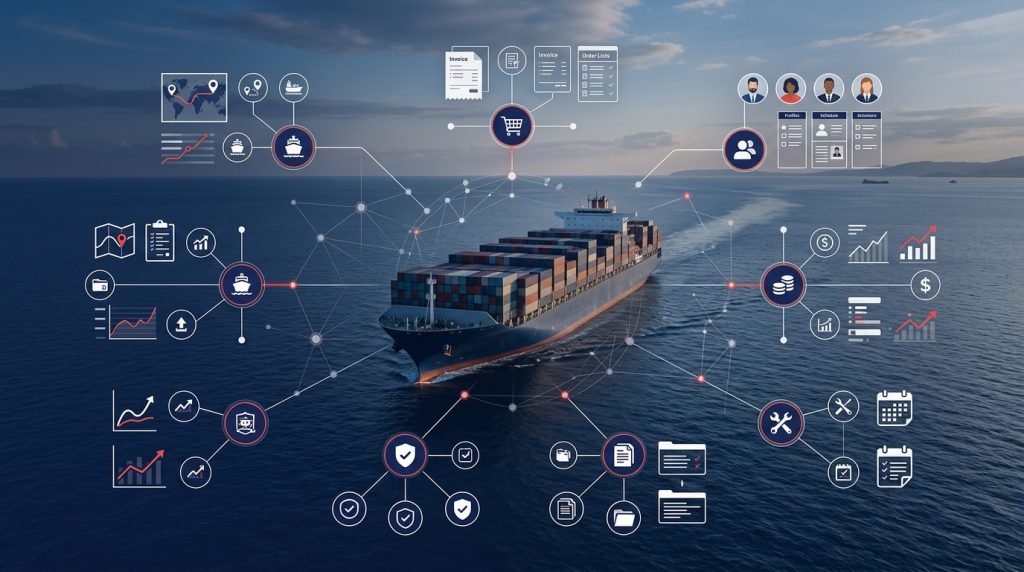
Quick View
At A Glance
Maritime fleet management software is an integrated cloud platform that unifies ship and shore operations across planned maintenance, procurement, crewing and HSEQ compliance. Driven by strict IMO decarbonization mandates and rising operational pressures, modern fleets are transitioning from fragmented spreadsheets to marine ERPs, cutting unplanned machinery downtime by up to 25% while ensuring audit readiness and fleet-wide OPEX transparency.
Introduction: The Shift from Spreadsheets to Cloud ERP
For decades, commercial shipping operated on disconnected manual systems: standalone desktop databases aboard vessels, voluminous paper binders in the control room, and endless spreadsheets emailed across time zones to shore superintendents. Today, that fragmented operational model has reached its breaking point.
Between stringent global decarbonization mandates (such as the IMO Carbon Intensity Indicator and FuelEU Maritime), complex vetting frameworks (SIRE 2.0 and TMSA 3), and intense commercial pressure on charter rates and operating margins, shipping companies can no longer afford operational blind spots.
Key Industry Benchmark
Fleets that transition from disconnected spreadsheets to an integrated cloud maritime fleet management system report significant reductions in unplanned maintenance downtime and fewer administrative reporting hours
Modern maritime fleet management software, also known as a vessel management system or ship management software, has evolved from simple record-keeping software into the central nervous system of maritime enterprises. In this definitive 2026 guide, we explore what modern fleet software encompasses, the mssion-critical modules required by competitive ship managers, how cloud architecture solves the ship-to-shore connectivity gap and how to evaluate platforms for your fleet.
What is Maritime Fleet Management Software?
Maritime Fleet Management Software is an integrated software suite and database architecture specifically engineered for shipowners, technical managers, and commercial operators to plan, execute, monitor and optimize technical, operational, regulatory and financial workflows across a fleet of vessels and shore-based offices.
Unlike generic Enterprise Resource Planning (ERP) tools or standard asset management applications, maritime fleet management platforms are built specifically to handle the harsh realities of maritime logistics: intermittent low-bandwidth satellite communications, strict classification society requirements (China Classification Society), international maritime laws (SOLAS, MARPOL, STCW, MLC 2006), and rotational multinational workforces.
Core Modules Every Ship Manager Needs
A robust maritime fleet management platform acts as a unified operating system. While individual requirements vary between dry bulk, tankers, container vessels, and offshore support vessels (OSVs), four core operational pillars form the foundation of any high-performing system:
1. Planned Maintenance Systems (PMS)
Unplanned machinery failure at sea carries catastrophic financial and safety consequences. The PMS module establishes structured, manufacturer-recommended maintenance intervals based on calendar days, running hours or condition-based monitoring triggers.
- Component Hierarchies: Deep multi-level equipment trees (from Main Engine down to individual cylinder liners and fuel injectors).
- Job Cards & Work Orders: : Step-by-step technical procedures, safety procedures (e.g. tool requirements, and required spare parts attachments)
- Class Society Surveys: Continuous survey cycles (CSM), Continuous Survey of Boilers (CSB) tied directly to maintenance logs, allowing surveyors to verify maintenance histories in minutes.
- Running Hour Integration: Automated data ingestion from engine room automation systems or simple daily log inputs by shipboard engineers.
Marine procurement is notorious for logistical friction, emergency shipping surcharges, and customs bottlenecks in foreign ports. A dedicated marine purchasing module streamlines the entire lifecycle:
- Requisition to PO Workflow: Vessel engineers raise digital requisitions directly linked to PMS job requirements and current inventory levels.
- Catalog Standardization: Integration with industry standards such as IMPA marine store guides to eliminate part ambiguity.
- Automated RFQs & Bid Comparison: Shore purchasing teams can broadcast Requests for Quotation (RFQs) to approved global vendors, analyze delivery costs freight, price, and lead-time differentials side-by-side, and issue Purchase Orders (POs) with automated approval hierarchies.
- Delivery & Receipt Ingestion: Monitoring the delivery status of ordered parts to the designated port, and digitizing the final receipt when items are loaded onto the vessel
With crew-related expenses representing one of the largest portions of a vessel’s daily operating costs, crewing management is both a compliance necessity and a human resources priority:
- Matrix & Certification Compliance: Automated validation of STCW certificates, flag state endorsements, medical clearings and customer-specific vetting matrices (e.g., OCIMF crew experience matrix).
- Rotation & Relief Planning: Visual gantt-chart scheduling to prevent gaps in mandatory vessel manning requirements.
- Multi-Currency Payroll: Generation of shipboard allotments, cash-to-master accounts, overtime tracking, and home-remittance distribution across multiple currencies.
- MLC 2006 Rest Hours: Daily digitized logging of work and rest periods with built-in predictive warnings before non-conformities trigger Port State Control detentions.
4. HSEQ & Compliance (Health, Safety, Environment, Quality)
Regulatory oversight in commercial shipping has never been more demanding. The HSEQ module ensures compliance with the International Safety Management (ISM) Code, ISPS Code, and international environmental frameworks:
- Digital Safety Management System (SMS): Centralized document control guaranteeing that vessels always carry the latest approved operating procedures and checklists.
- Incident & Near-Miss Reporting: Root-cause analysis workflows, corrective and preventive action (CAPA) tracking, and statistical trend analysis.
- Audit & Vetting Management: Dedicated prep checklists and findings trackers for internal audits, Class surveys, Flag State inspections, SIRE 2.0, and CDI vetting.
- Environmental Logbooks: Digital tracking for MARPOL Annex I through VI compliance, Garbage Record Books, Ballast Water Management, and voyage-level emissions logging (CII / EU MRV).
Cloud vs. On-Premise: Which is Better for Shipping?
The maritime industry historically relied on on-premise local servers installed in the head office paired with local shipboard databases. Today, modern cloud architectures dominate new implementations.
| Feature / Criteria | Legacy On-Premise Systems | Modern Cloud Marine ERP |
|---|---|---|
| Server Infrastructure | Expensive on-site physical servers; high maintenance | Scalable, secure cloud hosting (AWS / Azure / SDSD Cloud) |
| Data Synchronization | Heavy, batch-file email exchanges prone to data conflicts | Lightweight, compressed, bi-directional delta sync |
| Access Anywhere | Requires VPNs or terminal servers; desktop-locked | Accessible via any modern web browser and mobile tablet |
| Updates & Upgrades | Costly manual upgrades; versions drift out of sync | Automatic continuous updates with zero server maintenance |
| Cybersecurity | Vulnerable to local office network exploits and malware | Enterprise encryption and MFA |
| Vessel Connectivity | Fails entirely during intermittent connectivity | Native offline-first database running on ship’s local LAN |
Expert Insight
True maritime cloud software must be ‘offline-first.’ A pure web application that requires constant internet will fail in the middle of the Pacific Ocean. The gold standard is a local vessel cache that synchronizes only the updated data changes whenever bandwidth is detected.
How Modern ERP Unifies Ship and Shore
The single biggest failure of legacy vessel management is operational lag. When a chief engineer logs an auxiliary engine bearing temperature anomaly on paper or in an isolated spreadsheet, shore superintendents often don’t find out until weeks later during end-of-month reporting.
Modern maritime fleet management platforms bridge this divide through smart data synchronization:
- Intelligent Data Sync: Only modified database fields are synchronized, reducing data packet sizes to mere kilobytes so they transmit effortlessly over restricted satellite connections.
- Easy Requisition Routing: When a critical maintenance task requires replacement parts, the integrated requisition process in the purchasing module enables users to raise a requisition simply from within the module.
- Executive Business Intelligence: Shore executives gain aggregate dashboards revealing fleet-wide fuel burn, ongoing overhaul costs, overdue maintenance tasks, and crew turnover metrics across all vessels.
Conclusion: Future-Proofing Your Fleet
Managing a modern commercial fleet without dedicated maritime software is no longer viable. Between rising environmental enforcement, aggressive commercial vetting, and the rising cost of spares and fuel, operators who rely on manual workflows risk crippling detentions, off-hire penalties, and spiraling OPEX.
Investing in modern maritime fleet management software transforms your operations from reactive firefighting to proactive, data-driven fleet stewardship.
FREQUENTLY ASKED QUESTIONS
What is the difference between a PMS and a full Marine ERP?
A Planned Maintenance System (PMS) is a single, dedicated module focused specifically on machinery maintenance, running hours, and technical spare parts. A full Marine ERP is a complete management suite that unifies PMS with procurement, crew management, HSEQ compliance, voyage tracking, and financial accounting into one central database.
Can maritime fleet management software operate without an active internet connection?
Yes. Quality maritime software uses an ‘offline-first’ architecture. The crew interacts with a local vessel server or desktop client on the ship’s local area network (LAN) with zero latency. When internet connectivity is available, the software automatically syncs; alternatively, users can schedule updates.
How does fleet management software ensure compliance with Class Societies?
Class societies (such as CCS, PSC, and ClassNK) require verifiable proof that safety-critical equipment is maintained according to manufacturer specifications. Marine fleet management systems maintain immutable, timestamped audit trails of every maintenance job, spare part used, and engineer sign-off, enabling rapid digital certification during annual surveys.
How long does it take to implement fleet management software across 10-20 vessels?
A standard phased rollout typically takes between 3 to 6 months. This includes database configuration, legacy data migration (equipment hierarchies, spare part catalogs, running hours), superintendent training, and shipboard commissioning.
Ready to Upgrade Your Fleet Operations?
Empower your superintendents and crew with an integrated, Class-approved marine ERP platform.