 sales@sdsd.com
  UK: +44 20 3588 6740 Singapore: +65 3158 7545 Indonesia: +6282145732154
 +6593564863

Reducing Vessel OPEX with Planned Maintenance: A Practical Guide for Indonesian Shipping Companies
A well‑implemented Planned Maintenance System (PMS) can reduce vessel maintenance‑related OPEX by 10–30%, cut emergency repair costs by 2–3x, and significantly lower off‑hire losses for Indonesian ship operators.

Reducing Vessel OPEX with Planned Maintenance: A Practical Guide for Indonesian Shipping Companies
Key Takeaway: A well‑implemented Planned Maintenance System (PMS) can reduce vessel maintenance‑related OPEX by 10–30%, cut emergency repair costs by 2–3x, and significantly lower off‑hire losses for Indonesian ship operators.
Why Maintenance Failures Drive Up OPEX
On 10 December 2019, the Maju 8 collided with the Shinpo 16 at Lewoleba Port. Investigators found that earlier engine failures had not been recorded or reported, and no evidence of pre‑maneuvering engine tests was available.
“The problem had happened before the accident. It simply wasn’t properly tracked.”
This is a common pattern across fleets:
- A routine service is postponed
- Running hours are not logged
- A spare part is unavailable
- Completed work is not recorded
Small gaps compound into equipment failure, emergency repairs, downtime, and higher OPEX – especially in Indonesia’s dispersed archipelago, where vessels operate far from shore support.
Indonesia Cargo Fleet: Maintenance OPEX at a Glance

20–40% of total vessel OPEX is maintenance‑related (ABS & DNV fleet OPEX benchmarks).
- 2–3× higher cost for reactive/emergency repairs vs planned work (McKinsey Global Maintenance Study).
- USD 15k–50k/day potential off‑hire losses for mid‑size cargo vessels (Clarksons World Fleet Register).
These numbers reflect global benchmarks but align closely with Indonesian operators’ cost structuress
The Hidden Cost Drain: Where Manual Maintenance Fails
Indonesia’s maritime sector operates across one of the world’s largest archipelagos, creating unique operational challenges. A vessel may move between major commercial ports, smaller regional ports, and offshore locations while carrying cargo. Maintenance planning cannot depend entirely on shore-based teams.
Without a structured digital system, information becomes fragmented across engine-room logbooks, spreadsheets, emails, and paper records. Three distinct cost leaks emerge:

| The Inspection Gap | Without Digital: Reactive maintenance dominates. “Why did this equipment fail?” | With PMS: Shifts to planning. “What do we need to do to reduce the likelihood of failure?” |
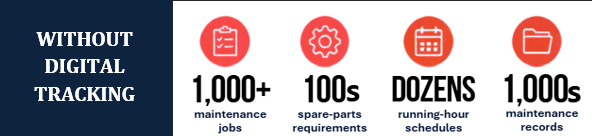
| The Data Silo | Without Digital: A fleet of 10 vessels means manually managing 1,000+ jobs, 100s of spare parts, and 1,000s of records. | With PMS: Fleet managers and superintendents get shore-to-vessel visibility on one platform. |
| The Compliance Scramble | Without Digital: Missing records during audits. Fails to demonstrate what was planned or deferred. | With PMS: Structured audit trails prove the maintenance system is being implemented correctly. |
| Fuel Quality & Lab Analysis | $1,200 – $2,800 | Per Bunkering |
The Five Core Elements of an Effective Marine PMS
A Planned Maintenance System (PMS) is a structured system for scheduling, executing, recording, and monitoring maintenance activities across a vessel. Here are the five core elements driving down OPEX:
| Equipment Hierarchy | Maintenance Scheduling | Work Order Management | Spare Parts Integration | Maintenance History & Performance |
|---|---|---|---|---|
| Organizes hundreds of components clearly. Helps identify recurring issues and control costs which account for 20-40% of vessel OPEX. | Triggers tasks based on calendar dates or running hours. Avoids premature servicing and missed maintenance. | Assigns, tracks, and records each job. Creates a history to prevent repeat failures. | Links jobs to required spares. Better management cuts maintenance costs by 5-15% while reducing urgent purchases. | Reveals recurring failures and rising repair costs. Effective optimization reduces future maintenance activity costs by 5-15%. |
Impact: Operators typically see 5–15% reduction in maintenance activity costs when PMS data is used to optimize intervals and spare‑parts planning (DNV Maintenance Optimization Report).
Beyond Compliance: Keeping Indonesian Vessels Inspection-Ready
Under the ISM framework, companies are required to establish procedures to ensure ships and equipment are maintained in conformity with relevant rules. During audits, surveys, and inspections, the question is not simply whether a company has a maintenance program. The records need to demonstrate what was planned, completed, deferred, and what action was taken.
A digital PMS provides a structured audit trail for this information.
Planned Maintenance vs Reactive Maintenance
The difference between planned and reactive maintenance is simple.
| Reactive maintenance | Planned maintenance |
| “What do we do now that the equipment has failed?” | “What do we need to do to reduce the likelihood of failure?” |
Reactive maintenance will always exist, but when it becomes dominant, operators face:
- Unplanned downtime
- Emergency repair premiums
- Higher spare‑parts costs
- Voyage delays
- Safety risks
- Audit failures
A PMS doesn’t eliminate failures, it reduces avoidable failures and provides visibility before issues escalate.
Why Digital PMS Matters for Indonesian Fleet
As fleet size grows, so does the maintenance load.
A fleet of 10 vessels can mean:
Offline Capability Is Particularly Important at Sea
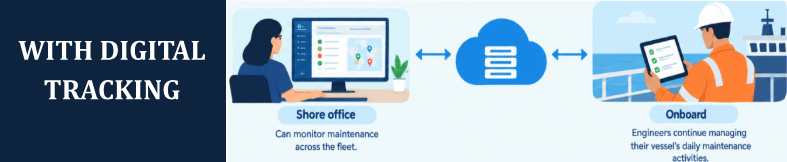
Marine maintenance software cannot assume a vessel will always have a reliable internet connection. Vessels operate in areas where connectivity is limited. A practical marine PMS allows the crew to continue working with maintenance information onboard, with data synchronized when communication becomes available. This ensures the maintenance process never stops.

The Fleet-Wide Shift: Implementing PMS to Control Maintenance Costs
Moving from spreadsheets or paper records to a digital PMS should be approached systematically:
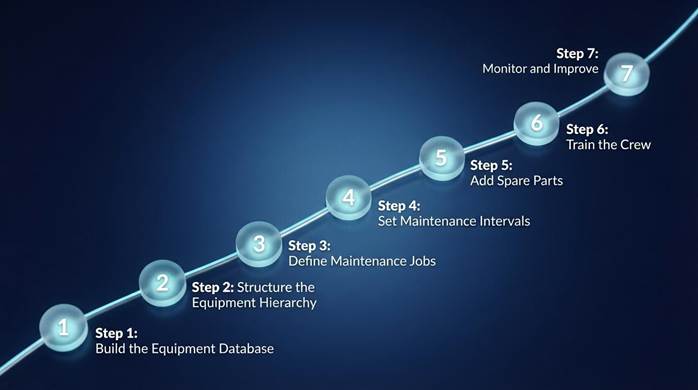
- Step 1: Build the Equipment Database – Start with an accurate inventory of the vessel’s equipment.
- Step 2: Structure the Equipment Hierarchy – Organize equipment into systems, equipment, components and sub-components.
- Step 3: Define Maintenance Jobs – Create tasks based on manufacturer recommendations, company procedures, and class requirements.
- Step 4: Set Maintenance Intervals – Assign the appropriate calendar or running-hour interval to each task.
- Step 5: Add Spare Parts – Connect required spare parts to relevant equipment and maintenance jobs.
- Step 6: Train the Crew – Make sure engineers understand not only how to use the system but why accurate maintenance records matter.
- Step 7: Monitor and Improve – Use maintenance data to identify overdue work, recurring failures, unrealistic intervals, and opportunities to improve fleet performance.
MAMS: Optimizing Fleet Maintenance and Reducing Costs in Indonesia
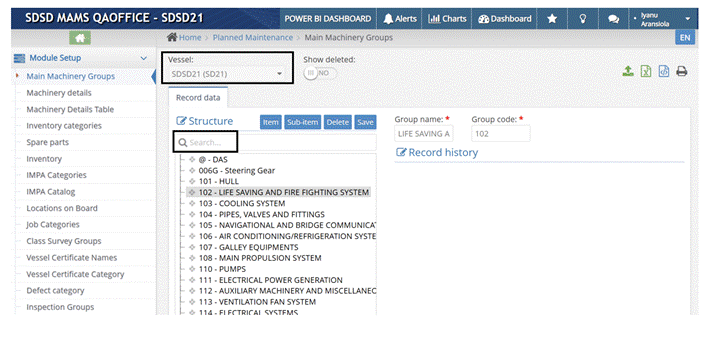
MAMS provides a digital PMS designed specifically for Indonesian fleets, with:
- Calendar & running‑hour scheduling
- Work order management
- Spare‑parts integration
- Offline vessel capability
- Fleet‑wide dashboards for superintendents
- Structured audit trails for ISM & DJPL compliance
Fleet managers gain visibility across vessels. Engineers gain clarity on what is due, overdue, or upcoming.
Measurable KPI: How PMS Reduces OPEX
Based on global benchmarks and Indonesian fleet data:
| KPI | Typical Improvement with PMS |
Emergency repair costs | ↓ 30–60% |
Maintenance‑related OPEX | ↓ 10–30% |
Off‑hire days | ↓ 20–40% |
Spare‑parts expenditure | ↓ 5–15% |
Audit findings related to maintenance | ↓ 50–80% |
These improvements come from better scheduling, fewer breakdowns, and structured record‑keeping.
Conclusion
For Indonesian shipping companies, effective vessel maintenance requires more than a list of jobs and due dates. It requires a system that connects equipment, maintenance schedules, work orders, spare parts, crew activities, and maintenance history.
For Indonesian shipping companies, controlling vessel OPEX requires more than a list of jobs. It requires a digital system that connects equipment, schedules, work orders, spare parts, crew activity, and maintenance history.
A PMS helps operators shift from reactive firefighting to proactive planning, reducing breakdowns, improving compliance, and lowering OPEX through measurable KPIs.
Ready to Control Your Maintenance Costs?
Don’t let reactive maintenance drain your OPEX. MAMS Planned Maintenance System gives Indonesian shipping companies the tools to plan, track, and manage maintenance across their fleet from a single platform.
FREQUENTLY ASKED QUESTIONS
Does ISM software meet the requirements of major Classification SocietiHow quickly can our fleet see a reduction in maintenance costs?
es?
Most operators begin seeing efficiency gains and cost reductions within the first few months of implementing MAMS. By preventing missed services and emergency breakdowns, you avoid the high premium of reactive repairs, which typically cost 2-3x more than planned work.
Does MAMS work when our vessels are in remote Indonesian waters without internet?
Yes. MAMS is designed with offline capability. Crew members can log maintenance, check off tasks, and view schedules entirely offline. Once the vessel enters an area with internet connectivity, the system automatically syncs with the shore office.
How does a PMS help with ISM and DJPL compliance?
Under ISM and local DJPL regulations, having a maintenance program isn’t enough—you must prove it’s being followed. MAMS provides a structured, digital audit trail of all planned, completed, and deferred work, making it incredibly easy to demonstrate compliance during port state controls, surveys, or audits.
Is it difficult to transition from spreadsheets to MAMS?
Transitioning takes some initial setup (like building your equipment database and hierarchy), but MAMS is designed for ease of use. Once the equipment is mapped and intervals are set, the system automates the scheduling, drastically reducing the administrative burden on your crew and shore managers.