 sales@sdsd.com
 UK: +44 20 3588 6740 Singapore: +65 3158 7545 Indonesia: +6282145732154
 +6593564863

Preventing Port State Control Detentions Penalties with Rest Hours Compliance Software
Rest hours compliance software automates the planning, recording, and validation of seafarer working arrangements in strict compliance with MLC 2006 and STCW 2010 mandates.

Preventing Port State Control Detentions Penalties with Rest Hours Compliance Software
Quick View
At A Glance
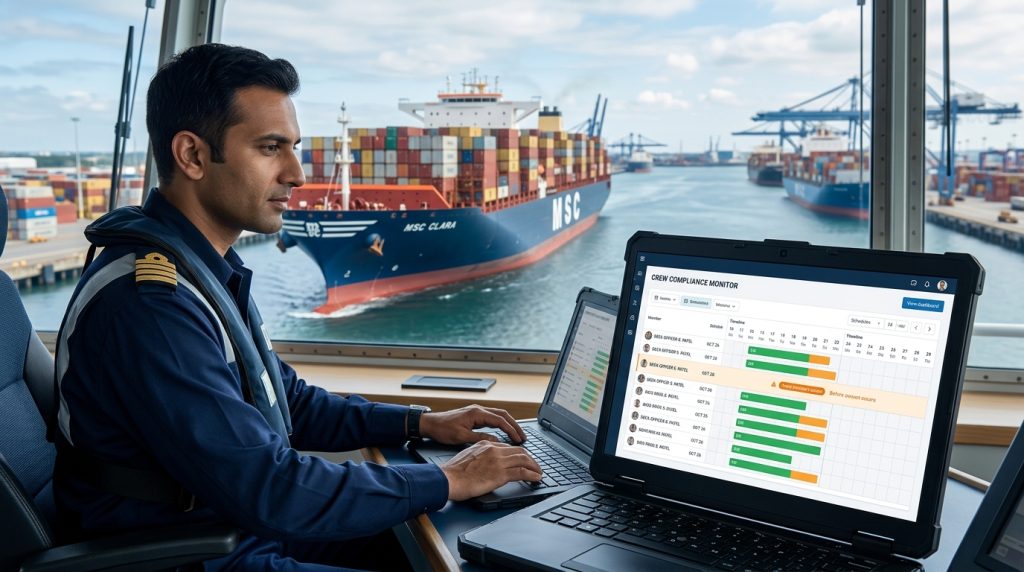
Rest hours compliance software automates the planning, recording, and validation of seafarer working arrangements in strict compliance with MLC 2006 and STCW 2010 mandates. By replacing error-prone manual spreadsheets with an offline-first digital rules engine, the software identifies potential rest violations in advance. This proactive approach eliminates fraudulent ‘magic marker’ logging, streamlines port state control inspection preparation, protects shipowners from costly PSC detentions and regulatory non-compliance penalties, and synchronizes seamlessly with maritime crew management software and maritime payroll software
Introduction: The Operational Reality of Crew Fatigue and Port State Control Scrutiny
In the high-stakes operational tempo of modern commercial shipping, turnaround times are compressed, vessel sailing schedules are relentless, and crew complements are lean. Around-the-clock port operations, pilotage through congested littoral choke points, intensive cargo handling, and mandatory safety drills create a compounding fatigue environment for seafarers.
Fatigue directly degrades situational awareness, cognitive reaction times, and risk assessment capabilities on the navigating bridge and in the engine room. Rigorous investigations by the International Maritime Organization (IMO), the International Labour Organization (ILO), and leading Protection and Indemnity (P&I) Clubs confirm that human factor errors contribute to between 75% and 96% of all maritime casualties, with chronic seafarer fatigue cited as a decisive root cause.
Key Industry Benchmark
Port State Control statistics across the Paris MoU and Tokyo MoU consistently position seafarers’ hours of work and rest among the top five most frequent areas of non-compliance under the Maritime Labour Convention (MLC 2006). Even more critical for shipowners, systemic rest hour violations are among the primary triggers for Action Code 30: immediate vessel detention, which halts commercial trading and costs operators tens of thousands of dollars per day – SDSD Crew & Rest Hours Product Team
As a result, Port State Control (PSC) regimes worldwide, including the Paris MoU, Tokyo MoU, United States Coast Guard (USCG), and the Australian Maritime Safety Authority (AMSA), have sharply escalated their enforcement postures. Rest hours are no longer treated as routine administrative record-keeping; they are scrutinized as frontline life-safety indicators. Shipping companies that rely on manual spreadsheets or retroactively doctored paper binders face catastrophic financial penalties, immediate vessel detentions, and commercial blacklisting by charterers.
What is Rest Hours Compliance Software?
Rest Hours Compliance Software is a specialized maritime digital platform engineered to schedule, record, calculate, and verify seafarers’ daily hours of work and rest in strict accordance with MLC 2006 Regulation 2.3 and STCW 2010 Section A-VIII/1 requirements, employing automated calculation engines to prevent Port State Control detentions, eliminate non-compliance penalties, and synchronize vessel records with shore-side crew management and payroll systems.
Unlike generic HR timesheets or office attendance applications, dedicated rest hours compliance software is built specifically for the operational realities and regulatory intricacies of commercial shipping. It accounts for complex rolling 24-hour windows, multi-week averaging rules, operational emergency exceptions, and international maritime labor standards.
Crucially, high-performance rest compliance software utilizes an offline-first architecture. It operates reliably on the ship’s local network (LAN) or mobile devices without requiring continuous satellite connectivity. Whenever internet bandwidth is detected, the platform automatically compresses and synchronizes encrypted compliance logs with shore-side crewing teams, safety directors, and the Designated Person Ashore (DPA).
Understanding MLC 2006 and STCW Rest Hour Requirements: The Mathematical Rules
Managing rest hour compliance at sea requires navigating two rigorous, overlapping international conventions: the Maritime Labour Convention, 2006 (MLC 2006 Standard A2.3) and the International Convention on Standards of Training, Certification and Watchkeeping for Seafarers (STCW 2010 Section A-VIII/1, Manila Amendments). While both frameworks seek to safeguard seafarer health and operational safety, their mathematical constraints present significant administrative challenges.
The Core Compliance Thresholds
Under international maritime law, ship managers and masters must ensure that all onboard working arrangements satisfy the following statutory limits:
- Minimum Daily Rest: Seafarers must be provided with no less than 10 hours of rest in any 24-hour period.
- Minimum Weekly Rest: Total rest must not be less than 77 hours in any seven-day period.
- Division of Rest Periods: Daily rest may be divided into no more than two periods, one of which must be at least 6 consecutive hours in duration.
- Maximum Interval Between Rest: The interval between consecutive periods of rest must not exceed 14 hours.
The ‘Rolling 24-Hour Window’ Calculation Trap
The most frequent reason why manual record-keeping leads to severe Port State Control issues is the fatal misunderstanding of the ‘any 24-hour period’ mandate. When using spreadsheets, crew members almost invariably calculate total rest hours across a fixed calendar day (from 00:00 to 24:00).
However, Port State Control officers and vetting inspectors evaluate compliance across a continuous, rolling 24-hour window calculated from every single hour of the day. A seafarer can log 10 hours of rest on Monday and 10 hours of rest on Tuesday, yet completely violate the 10-hour rule when measured across a rolling window from 14:00 Monday to 14:00 Tuesday due to watchkeeping splits. Dedicated rest hours compliance software computes all 24 overlapping hourly windows continuously in real time, eliminating this mathematical trap.
STCW Manila Exceptions and Operational Realities
Both MLC 2006 and STCW recognize that maritime operations cannot always adhere to rigid schedules. Section A-VIII/1, paragraph 9 of the STCW Manila Amendments permits authorized exceptions under strict statutory criteria:
- 70-Hour Weekly Exception: The minimum 77 hours of rest in any 7-day period may be reduced to no less than 70 hours.
- Three-Period Division: Daily rest may be divided into no more than three periods, one of which must be at least 6 hours, and neither of the other two less than 1 hour.
- Strict Duration Limits: Exceptions cannot be extended beyond two consecutive weeks, and the interval between two periods of exception onboard must not be less than twice the duration of the exception.
Furthermore, unscheduled musters, emergency firefighting drills, and emergency call-outs (such as unattended machinery space alarms) often disrupt mandatory rest. Under MLC 2006, any seafarer whose rest is disturbed by operational call-outs must be granted adequate compensatory rest. Tracking, scheduling, and legally documenting compensatory rest across a 24-person crew using manual logs is virtually impossible without specialized software.
The Risks of Non-Compliance: PSC Detentions, Financial Penalties, and Commercial Fallout
In many shipping circles, rest hour violations are casually described as ‘deficiencies.’ However, this outdated term obscures the severe financial, regulatory, and commercial damage that non-compliance inflicts upon shipowners and managers.
1. Port State Control Detentions (Action Code 30)
Under Port State Control inspection guidelines, systemic rest hour non-compliance or falsified records are categorized as serious threats to maritime safety. Rather than issuing an advisory action code, the PSCO will invoke Action Code 30: detention of the vessel. The ship is legally restrained from leaving port until:
- Mandatory Rest Recovery: All fatigued seafarers are stood down from duty and provided with mandatory continuous compensatory rest.
- Superintendent Root-Cause Investigation: The ship manager and DPA submit an approved Corrective and Preventive Action (CAPA) plan.
- Relief Manning Requirements: If crew members cannot satisfy safe rest limits, the ship must embark fresh relief officers before departure approval is granted.
2. Crippling Off-Hire and Operational Expenses
A commercial vessel placed under detention immediately goes off-hire. Depending on vessel sector (Capesize bulker, Suezmax tanker, or ultra-large container ship), daily charter hire losses range from $15,000 to over $60,000 per day. Compounding this loss are:
- Berth extension fees and pilotage re-booking charges levied by port authorities.
- Demurrage claims and cargo owner disruption liabilities.
- Hefty PSC re-inspection fees and classification society surveyor inspection costs.
- Emergency international crew flight bookings, accelerated visa handling, and local agent expenses.
3. Severe Statutory Fines and Regulatory Penalties
Port authorities and maritime administrations enforce severe financial non-compliance penalties against companies that breach seafarer rest hour laws. Regulatory agencies such as AMSA (Australia) and the USCG enforce strict penalties against both shipowners and individual masters for fraudulent logs or excessive work hours. Repeat offenses trigger port banning orders, barring vessels from entire regional maritime corridors for up to 12 months.
4. Commercial Vetting Rejections (SIRE 2.0, CDI, and RightShip)
For tanker and bulk carrier operators, commercial employment is dictated by vetting inspection performance. Under OCIMF’s SIRE 2.0 inspection framework, human factors and rest hour compliance are evaluated with deep analytical rigor. Similarly, RightShip algorithms penalize vessels with MLC-related PSC inspection findings. A single adverse rest hour observation often results in vetting rejection by oil majors and bulk charterers, voiding lucrative long-term charter party contracts.
5. Marine Casualty Liabilities and P&I Insurance Voidance
When a navigational collision, grounding, or serious workplace injury occurs, maritime accident investigation bodies (such as the UK MAIB or US NTSB) immediately impound and examine the vessel’s rest hour records. If logs reveal that bridge watchkeepers or engine officers were operating in chronic breach of rest rules, the consequences are disastrous:
- P&I clubs and Hull & Machinery insurers may challenge or repudiate insurance coverage on grounds of unseaworthiness with owner privity.
- Ship managers, technical directors, and masters face criminal prosecution and civil liability for gross negligence.
How Software Automates Rest Hour Recording and Eliminates Falsification
The root cause of most Port State Control rest hour issues is the persistence of paper timesheets and disconnected Excel spreadsheets. This outdated approach fosters the notorious ‘magic marker’ syndrome, where crew members retroactively fabricate work and rest hours just prior to port arrival to ensure all columns display compliant green values.
Exposing the ‘Magic Marker’ Vulnerability
Modern Port State Control officers and SIRE 2.0 vetting inspectors are highly trained to detect fabricated records. During inspections, they systematically cross-reference rest logs against independent shipboard records:
- Bridge and Engine Room Bell Books: Verifying whether logged rest overlaps with recorded standby, maneuvering, or arrival stations.
- Electronic Navigation Systems (ECDIS): Checking officer watch changeover timestamps against logged work hours.
- Cargo & Bunkering Logs: Cross-referencing deck officer rest periods against active cargo watch sign-offs.
- Permit to Work (PTW) Records: Confirming whether engineers logged as resting were actually executing enclosed space or hot work jobs.
When an inspector detects contradictions between rest sheets and physical operational logs, the vessel is immediately cited for fraudulent record-keeping, leading directly to detention and regulatory penalties.
Tamper-Proof Digital Logging and Verification Workflows
Dedicated rest hours compliance software replaces vulnerable spreadsheets with secure, structured digital workflows:
- Dual Digital Endorsements: At the conclusion of each accounting period, seafarers log their records electronically without signing. The Department Head and Master subsequently review the logged records for accuracy and completeness.
- Immutable Audit Trail: Every entry, modification, and exception note is permanently logged with an encrypted timestamp and user identifier, providing undeniable proof of genuine compliance.
- Instant Standardized Reporting: The software instantly compiles verified data into the official IMO/ILO Model Format of Records of Hours of Rest, ready for immediate presentation during port state control inspection preparation.
Flagging Violations Before They Happen: Predictive Lookahead Scheduling
The fundamental weakness of spreadsheet tracking is that it is purely historical: it informs management that an infraction occurred after the damage is already done. Advanced rest hours compliance software shifts the paradigm from reactive firefighting to predictive fatigue prevention.
Predictive Watch Schedule Modeling
Prior to complex evolutions, such as entering narrow straits, canal passages, or commencing round-the-clock cargo discharging, department heads can model proposed duty rosters directly inside the software. The predictive rules engine automatically projects planned schedules against historical rest data:
- 14-Hour Interval Warnings: Alerts officers up to 72 hours in advance if a proposed mooring schedule will result in more than 14 hours elapsed between rest periods.
- 77-Hour Cumulative Triggers: Flags watchkeepers who are on course to breach the weekly 77-hour rest threshold.
- 6-Hour Continuous Rest Protection: Detects when planned safety drills or bunkering watches will fragment an officer’s essential 6-hour unbroken sleep window.
Dynamic Roster Rebalancing and Compensatory Rest
With advance predictive warnings, the Master and Chief Engineer can adjust duty rosters before a violation occurs, for instance, assigning an off-duty second officer to take over cargo watch to protect the Chief Officer’s mandatory rest prior to departure. When an unavoidable emergency interrupts rest, the software automatically triggers a compensatory rest workflow, scheduling mandatory recovery rest into the seafarer’s forward roster to maintain full statutory compliance.
Manual Spreadsheets vs. Dedicated Rest Hours Compliance Software
The operational advantages of replacing manual spreadsheets with purpose-built rest compliance software are evident across every operational metric:
Operational Capability | Manual Spreadsheets (Excel) | Automated Rest Hours Compliance Software |
|---|---|---|
Calculation Engine | Fixed calendar day (00:00-24:00); fails rolling 24-hr check | Continuous rolling 24-hr and 7-day algorithm across all hours |
Violation Detection | Purely reactive; alerts only after breach has occurred | Predictive lookahead forecasting flags risks up to 72 hours ahead |
Audit Trail & Integrity | Easily altered; zero tamper protection; invites PSC suspicion | Immutable digital logs with dual seafarer/master endorsements |
| Compensatory Rest | Manual tracking; frequently forgotten or miscalculated | Automated tracking, roster insertion, and audit justification |
Ship-to-Shore Sync | Manual email attachments; delayed shore visibility | Lightweight offline-first delta sync directly to cloud ERP |
PSC Inspection Readiness | Hours spent printing and checking binders; high error risk | One-click generation of official IMO/ILO compliance reports |
Crewing & Payroll Link | Disconnected; requires redundant manual data entry | Native integration with crew matrices, safe manning, and payroll |
Vetting Acceptance | Frequently cited for discrepancies during SIRE 2.0 / CDI | Proven transparent audit trails fully accepted by oil majors |
Integrating Rest Hours with Maritime Crew Management and Maritime Payroll Software
Rest hour compliance should never operate as an isolated silo. When integrated into an enterprise marine ERP architecture, it creates powerful operational and commercial efficiencies across technical, human resource, and financial departments.
Synergies with Maritime Crew Management Software
Connecting rest hour tracking with your broader maritime crew management software unlocks critical fleet safeguards:
- Safe Manning Verification: The system continuously cross-references active duty rosters against the vessel’s Minimum Safe Manning Document (MSMD), ensuring that certified watchkeeping positions are never understaffed.
- Fatigue Trend Analytics: Shore-based crewing directors can analyze fleet-wide fatigue trends across specific ranks, vessel classes, or trading patterns, identifying operational bottlenecks before they cause accidents.
- Informed Crew Rotation Planning: Crew managers can assess cumulative workload when planning rotations, ensuring that newly embarked officers are rested and compliant before undertaking high-tempo port calls.
Conclusion: Generating PSC-Ready Reports Instantly
Managing seafarer rest hours via manual spreadsheets and paper timesheets is an unsustainable operational liability in modern commercial shipping. The financial consequences of Port State Control issues, including off-hire losses from Code 30 detentions, statutory non-compliance penalties, and commercial vetting rejections, far eclipse the investment required to implement modern compliance software.
By deploying dedicated rest hours compliance software, shipowners, technical managers, and masters transform rest tracking from a burdensome administrative obligation into a powerful operational shield. Automated mathematical checks, predictive scheduling alerts, and seamless integration with crew management and payroll software ensure that your fleet sails with total regulatory confidence at every port of call.
Protect Your Fleet from PSC Detentions and Non-Compliance Penalties
Experience how SDSD’s Rest Hours module delivers automated MLC 2006 and STCW compliance verification, predictive violation alerts, and seamless crewing and payroll integration.
FREQUENTLY ASKED QUESTIONS
How does rest hours compliance software calculate rolling 24-hour periods versus calendar days?
Standard spreadsheets evaluate rest from midnight to midnight (00:00 to 24:00). In contrast, rest hours compliance software utilizes a continuous sliding-window algorithm that evaluates every consecutive 24-hour interval throughout the voyage. Every hour of the day serves as the starting point of an independent 24-hour analysis. If total rest falls below 10 hours in any of these rolling windows, the software flags the non-compliance, precisely mirroring the forensic inspection methods used by Port State Control officers.
What happens when an unavoidable marine emergency or rescue operation causes a rest hour violation?
Both MLC 2006 and STCW grant the Master overriding authority to suspend normal rest schedules to ensure the immediate safety of the ship, persons onboard, or cargo, or to assist other vessels in distress. In such cases, the Master logs an ‘Operational Emergency Exception’ in the software with a formal justification note. Once normal operations resume, the software automatically prompts the allocation of mandatory compensatory rest and documents the recovery timeline for audit transparency.
Can the software operate onboard when satellite connectivity is lost at sea?
Yes. Professional rest hours compliance software is built on an offline-first architecture. The software functions natively on the ship’s local area network (LAN) and mobile devices. Seafarers and officers can record hours, approve rosters, and generate reports without internet access. As soon as the vessel establishes a satellite (Starlink/VSAT) or 4G/5G port connection, all data synchronizes automatically with the shore cloud database.
How does automated rest hour tracking satisfy Port State Control (PSC) and SIRE 2.0 vetting inspectors?
Automated software eliminates the suspicion that surrounds handwritten or spreadsheet logs. During inspections, the Master can immediately produce standardized IMO/ILO Model Format reports featuring complete digital signatures and timestamped audit trails. For SIRE 2.0 inspections, the system proves that the operating company actively monitors human factors and prevents chronic fatigue, significantly reducing the likelihood of adverse vetting observations.
How does rest compliance software integrate with maritime payroll software?
Daily working hours verified by seafarers and the Master flow directly into the maritime payroll software module. The payroll engine compares logged working hours against contractual terms and collective bargaining agreements (CBA), automatically calculating regular vs. overtime hours, applying correct wage rates, and generating accurate multi-currency pay slips without duplicate data entry.