 sales@sdsd.com
  UK: +44 20 3588 6740 Singapore: +65 3158 7545 Indonesia: +6282145732154
 +6593564863

Planned Maintenance System for Ships: The Definitive Guide
A Planned Maintenance System (PMS) for ships is a structured technical management framework that schedules, tracks, and documents all vessel machinery and structural maintenance in compliance with ISM Code Section 10 and Class Society standards.

Planned Maintenance System for Ships: The Definitive Guide
Quick View
At A Glance
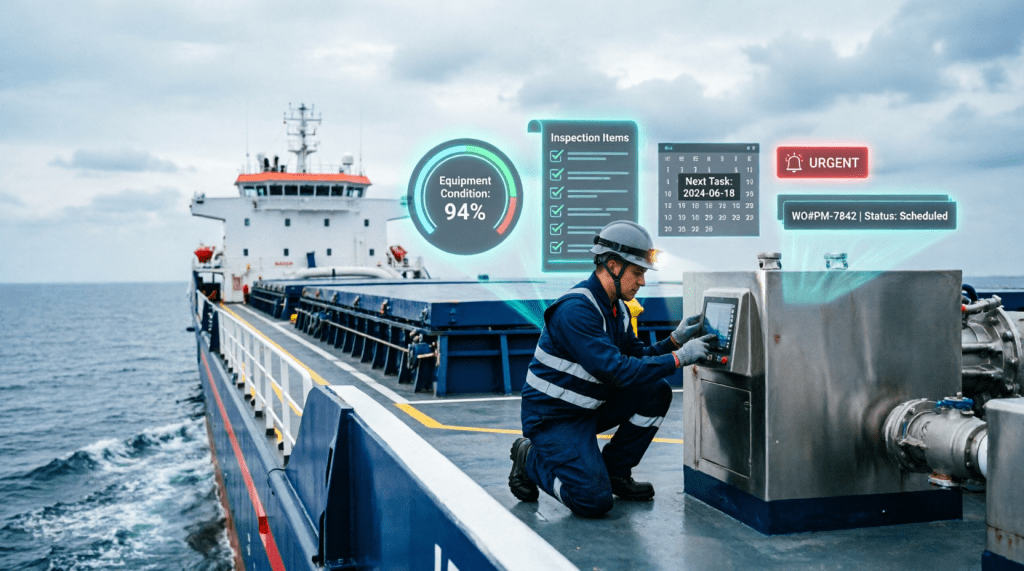
A Planned Maintenance System (PMS) for ships is a structured technical management framework that schedules, tracks, and documents all vessel machinery and structural maintenance in compliance with ISM Code Section 10 and Class Society standards. By integrating running-hour tracking, spare parts inventory, and condition-based monitoring, a modern PMS prevents catastrophic machinery failure at sea, slashes emergency repair costs, and ensures immediate digital audit readiness during Class and Port State Control inspections.
Introduction: The Cost of Unplanned Downtime
In the commercial maritime sector, machinery failure at sea is not merely an inconvenience – it is an operational and financial disaster. When a container vessel, bulk carrier, or tanker suffers a main engine blackout or auxiliary boiler failure, the financial repercussions escalate by the hour:
- Off-Hire Losses: Commercial charter penalties ranging from $15,000 to over $100,000 per day depending on the vessel class.
- Emergency Salvage & Towage: Millions in emergency tug assistance and port diversion fees.
- Expedited Air Freight: Astronomical charges to fly replacement turbochargers or fuel pumps to foreign anchorages.
- Reputational Damage: Commercial charterers avoid vessel operators with poor maintenance track records and repeated vetting failures.
The Cost of Reactive vs. Planned Maintenance
Studies across the commercial maritime industry show that emergency, reactive repairs cost between 3x to 5x more than scheduled, preventive maintenance managed through a certified ship PMS.
A robust planned maintenance system for ships – powered by modern vessel maintenance software is the single most effective barrier against unexpected downtime and spiraling technical OPEX.
What is a Planned Maintenance System (PMS)?
Planned Maintenance System (PMS) for Ships is a standardized software and operational methodology that enables ship operators to plan, schedule, record, and verify all maintenance tasks and inspections across hull and machinery components in accordance with manufacturer specifications, flag state regulations, and classification society requirements.
It covers every critical system onboard: main propulsion, auxiliary power generators, electrical distribution, steering gear, cargo handling equipment, safety and firefighting systems, and hull structural integrity.
Meeting IMO and Class Society Requirements
1. ISM Code Section 10 (Maintenance of the Ship and Equipment)
Section 10 of the International Safety Management (ISM) Code mandates that every shipping company must establish procedures to identify equipment and technical systems whose sudden operational failure could result in hazardous situations. The PMS must ensure:
- Inspections are conducted at appropriate intervals.
- Any non-conformity or defect is logged alongside its corrective action.
- Critical standby equipment (e.g., emergency fire pumps, emergency generators, steering gear backups) is tested systematically.
2. Class Society PMS Type Approvals and CSM Schemes
Major classification societies (CSS, Bureau Veritas) operate Continuous Survey of Machinery (CSM) and Planned Maintenance Schemes. Under an approved PMS scheme:
- Chief Engineers are authorized to survey and overhaul specific machinery components without having a Class Surveyor physically present for every individual task.
- The Class Surveyor reviews the software’s maintenance logs and running hour records during the annual audit.
- Using a Class-certified PMS software platform significantly reduces surveyor fees and dry dock inspection times.
Preventive vs. Predictive Maintenance in Shipping
Modern vessel maintenance software blends three distinct maintenance philosophies:
| Maintenance Approach | How It Works in PMS | Ideal Use Case | Pros & Cons |
|---|---|---|---|
| Preventive: Calendar-Based | Triggers tasks every N days, weeks, or months regardless of usage. | Safety equipment, lifeboats, fire dampers, hull cathodic protection. | Pro: Simple to schedule. Con: Can cause premature overhauls. |
| Preventive: Running-Hour Based | Triggers work orders automatically when machinery running hours reach pre-set limits. | Main engines, auxiliary generators, air compressors, purifiers. | Pro: Perfectly aligns maintenance with actual machinery wear. |
| Predictive: Condition-Based (CBM) | Monitors physical parameters (vibration analysis, lube oil spectrography, thermal imaging). | Critical bearings, turbochargers, electrical switchboards. | Pro: Eliminates unnecessary overhauls; catches catastrophic failures early. |
How PMS Software Works Onboard vs. Ashore
An enterprise ship PMS coordinates tasks seamlessly between shipboard engineers and shore superintendents:
- Shipboard Engineering Team: Records daily machinery running hours, receives automatic overhaul alerts, executes step-by-step job cards, attaches photo evidence/clearance measurements, and signs off tasks (automatically deducting consumed spares from stock).
- Bidirectional Synchronization: The architecture automatically compresses and encrypts updated records into lightweight email packets (typically under 20kb). Large files are automatically split into smaller packets to ensure reliable transmission over vessel satellite connections, while detailed sync logs track every transfer.
- Shore Technical Superintendents: Reviews technical clearance data, approves sign-offs, monitors inventory replenishment thresholds, and tracks fleet-wide maintenance health scores.
Top KPIs to Measure PMS Effectiveness
- Overdue Maintenance Ratio: Target: Maintain the lowest possible number of active maintenance jobs overdue across the fleet.
- Critical Equipment Uptime: Target: Maximize uninterrupted availability on main propulsion, power generation, and steering gear.
- Unplanned vs. Planned Work Order Ratio: Target: Ensure the vast majority of executed work orders are planned/preventive rather than reactive.
- Inventory Discrepancy Rate: Target: Minimize any variance between digital PMS stock counts and physical holds.
- Class Survey Deficiency Rate: Target: Zero condition of class (CoC) or PMS-related PSC detentions.
Conclusion: Upgrading Your Maintenance Strategy
A Planned Maintenance System is more than a compliance checkbox, it is the foundation of asset integrity, crew safety, and cost control across your fleet. Transitioning from antiquated spreadsheets or clunky legacy software to a modern, cloud-connected PMS empowers your engineers and protects your bottom line.
FREQUENTLY ASKED QUESTIONS
What happens if a vessel operates without an approved PMS?
Operating without a verifiable Planned Maintenance System violates Section 10 of the ISM Code and SOLAS regulations. This can result in immediate vessel detention by Port State Control (PSC), invalidation of classification certificates, suspension of the Document of Compliance (DOC) and Safety Management Certificate (SMC), and potential denial of insurance claims by P&I Clubs in the event of an accident.
How does the PMS interact with spare parts inventory management?
A true marine PMS links every maintenance task directly to its required spare parts list. When a work order is signed off (e.g., replacing mechanical shaft seals), the software automatically deducts the exact quantity used from the shipboard inventory and notifies the procurement department if stock drops below minimum safety thresholds.
Upgrade Your Fleet’s Maintenance Strategy
Discover how SDSD’s Class-approved Planned Maintenance System streamlines technical management and cuts vessel OPEX.